The identification, assessment, structuring and dissemination of past and present knowledge of pre-disposal R&D activities accumulated within the European Commission R&D programmes as well as international and national radioactive waste management organisations, is of vital importance for early-stage radioactive waste management programmes, advanced programs and future generations. It was the objective of this package to provide access to this knowledge in a systematic and structured way to the participants of the PREDIS beneficiaries and later to the European pre-disposal community. The knowledge management (KM) work performed within this work package was aligned with the KM activities in the Joint Programme on Radioactive Waste Management (EURAD). The KM WP made use of the vast amount of knowledge and expertise existing in the PREDIS R&D WPs. The PREDIS KM work package was divided into four tasks to meet its objective.
- Development of Knowledge management programme
- State of knowledge
- Developing and implementing training programme
- Implementing a mobility programme
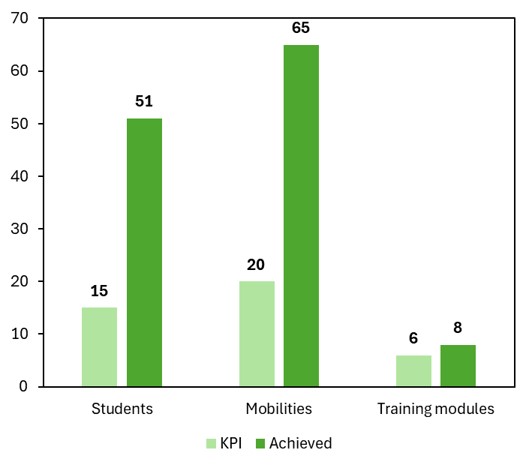
To help evaluate the quality of the work done in the WP, key performance indicators (KPIs) were fixed before the start of the project. The primary KPIs defined the project goals in terms of numbers of students, mobilities and training modules delivered by the PREDIS project. All KPIs were fully achieved as can be seen in the figure below.
Task 3.1 Knowledge management programme
This task relates to the strategic development of the complete PREDIS KM programme, structuring the KM work and to develop the PREDIS roadmap that is aligned with the EURAD roadmap. It is of significance to avoid duplication of work made in the past or in ongoing projects or programmes when developing the PREDIS KM programme and therefore pronounced attention is given to integrate initiatives made by e.g. IAEA, OECD/NEA, EDF (NUGENIA), EURAD, national and international initiatives. A central part of this task concerns development of the pre-disposal roadmap that corresponds to Theme 2: Predisposal activities in the EURAD roadmap) taking into account the pre-disposal end-users, stakeholders and community needs.
Predisposal Glossary was published in May 2022, based on the IAEA Safety Glossary published in 2018. The glossary consists of the key words to be commonly used in the work and deliverables of the PREDIS project. The purpose of this document is to support the PREDIS partners to use a consistent vocabulary in the project and dissemination.
For further information on activities and achievements on T3.1 please refer to deliverable D3.1 Report on adaptation of KMP to pre-disposal activities.
Task 3.2 State of Knowledge
Strongly coupled to the PREDIS roadmap built up in Task 3.1, this second task was responsible for populating the predisposal roadmap with State-of-Knowledge (SoK) documents having different levels of details depending on their level in the hierarchic roadmap structure. The authors of the SoK documents are subject matter experts active within the R&D WPs or external to PREDIS. More information on the PREDIS Roadmap can be found here and the SoK documents can be found here.
For further information on activities and achievements on T3.2 please refer to deliverable D3.2 Definition of demonstration case for S-of-Knowledge processes and D3.3 Outcome of pilot case and input to final report on KMP activities.
Tasks 3.3 and 3.4 Developing and implementing training and mobility programmes
PREDIS partners had special interest to make use of PREDIS training and mobility programmes to allow newcomers and new generations to acquire the level of knowledge needed to develop a professional career in the different subjects related to the predisposal of radioactive waste. The training and mobility programmes targeted young professionals (including PhD/PostDocs and trainees) associated with the PREDIS participating organisations. After surveying and prioritising PREDIS participants training needs and having performed a mapping of the required courses among European Radioactive Waste organisations, a match of the training needs and available courses was made and announced on the KM webpage. Requested courses on topics where no training in Europe existed were organized by KM WP during the project duration (offered courses are listed here).
For further information on activities and achievements on T3.3 please refer to deliverables D3.4 Design and Definition of training programme and D3.5 Implementing specialised training actions.
The Mobility programme followed a similar methodology as training. The main difference was that in this case the young researchers were supported for short stages in other institutions to develop specific research of interest for both organisations, the one sending the researcher and the one receiving it. The methodology followed to apply to a mobility is explained here.
For further information on activities and achievements on T3.4 please refer to deliverables D3.6 Priority list and mobility formats and D3.7 Summary report on activities of training and mobility grants.